Sales managers often struggle to bridge the gap between general sales knowledge and specific meeting execution. Optimizing sales training for meeting preparation requires shifting from generic product knowledge to account-specific coaching. You must standardize research workflows and leverage AI to scale pre-call strategy effectively.
Your reps already know the product, but they need targeted coaching on how to apply that knowledge to specific buyer contexts. Great sales managers do not just review lost deals; they coach reps on how to prepare so they do not lose the deal in the first place. This proactive approach is essential for winning Middle of Funnel deals.
The difference between a rep who wins and a rep who loses often comes down to preparation quality. Traditional sales training focuses on product features and sales methodologies, but it rarely addresses the specific context of each buyer relationship. This gap creates inconsistent performance across your revenue team.
Effective sales coaching must address this preparation gap directly. It requires account research and buyer alignment rather than relying solely on post-call conversational intelligence. Managers need to ensure reps enter the room with a tailored plan.
Why Is Meeting Preparation the Missing Link in Sales Coaching?
There is a critical gap between general sales skills learned in onboarding and actual meeting execution. Industry data indicates that B2B buyers frequently find sales reps unprepared for initial meetings. This highlights a massive failure in standard prep routines across the industry.
According to Gartner, buyers expect sales representatives to demonstrate a deep understanding of their business before the first call. When reps fail to meet this expectation, trust is lost immediately. This makes preparation the single most critical factor in early deal stages.
Effective sales coaching must bridge this gap by focusing heavily on pre-call strategy. It requires account research and buyer alignment rather than relying solely on post-call conversational intelligence. Managers need to ensure reps enter the room with a tailored plan.
The consequences of poor preparation extend beyond individual meetings. Reps who feel unprepared tend to be less confident, which buyers can sense immediately. This confidence gap directly impacts conversion rates and deal velocity.
Sales managers who invest in preparation coaching see measurable improvements in win rates. The investment pays for itself through reduced deal cycles and higher average deal sizes. This is why preparation should be a core component of your sales coaching framework.
Where Does Traditional Sales Training Fall Short Before the Call?
A vast majority of sales training is forgotten within 90 days if it is not continuously reinforced in real-world scenarios. This retention problem is well-documented by industry research firms like Forrester. Without reinforcement, the initial investment in training yields diminishing returns.
Traditional training focuses on static playbooks and generic personas. These resources fail to help reps navigate dynamic, account-level nuances during active deal cycles. A one-size-fits-all approach does not work for complex B2B sales environments.
Sales managers simply lack the hours to manually review every rep’s preparation for every single meeting. This leads to inconsistent readiness across the team. The time constraint is a major bottleneck for scaling effective coaching.
The result is a cycle where reps feel unsupported and managers feel overwhelmed. Training becomes a checkbox exercise rather than a continuous improvement process. This dynamic undermines the entire sales organization’s effectiveness.
Modern sales organizations need a different approach to training and coaching. They need systems that provide continuous reinforcement without requiring constant manager intervention. Technology can help bridge this gap effectively.
How Do Different Coaching Approaches Compare for Meeting Readiness?
Understanding the differences between coaching methods is vital for improving team performance. The table below compares the most common approaches used by sales leaders today.
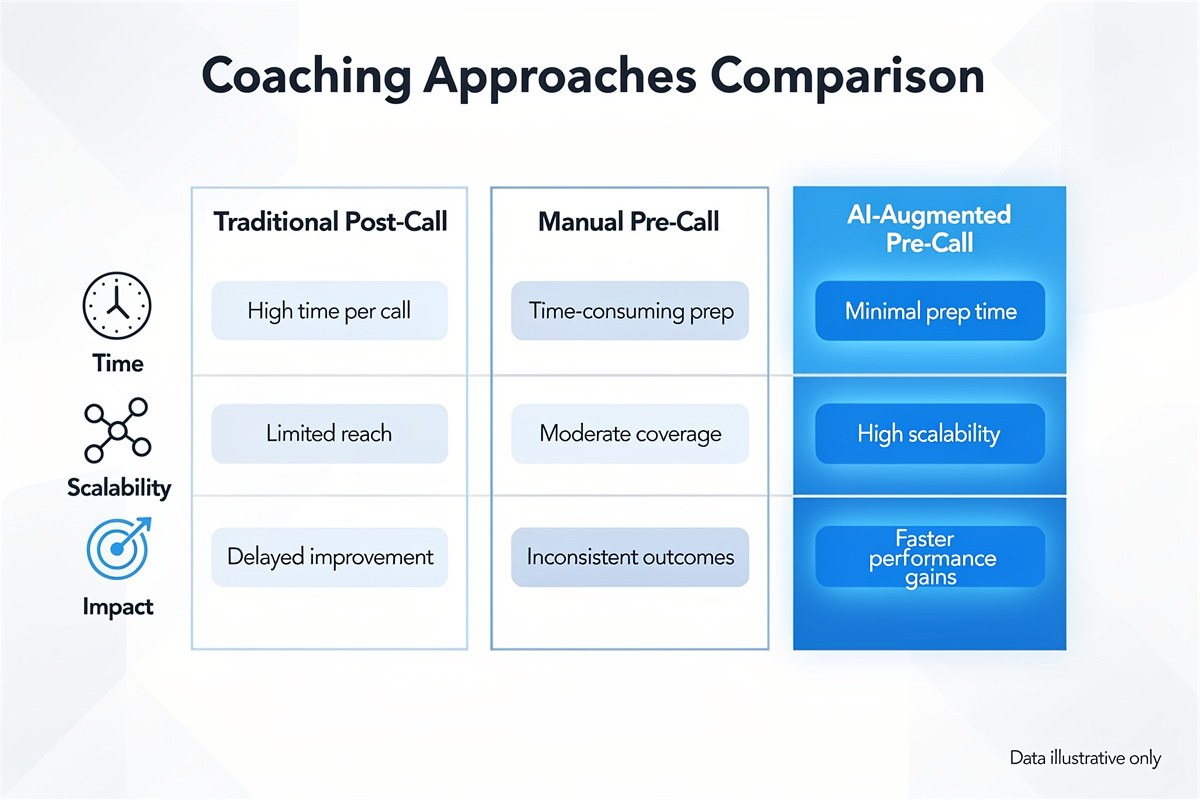
Traditional post-call coaching requires significant manager time but only provides reactive feedback. Reps learn from mistakes after the deal is already lost or won. This approach does not prevent lost opportunities.
Manual pre-call coaching has high impact but very low scalability. Managers spend hours reviewing each rep’s preparation individually. This approach works for small teams but breaks down as the organization grows.
AI-augmented pre-call coaching provides low time investment with high scalability and impact. It reduces the burden on managers while increasing the quality of every interaction. This approach ensures consistency without sacrificing personalization.
AI-augmented coaching provides the only sustainable way to scale personalized meeting prep across a growing revenue team. It reduces the burden on managers while increasing the quality of every interaction. This approach ensures consistency without sacrificing personalization.
What Are the Essential Steps to Coach Reps Before a High-Stakes Meeting?
Coaching reps on preparation requires a structured framework that guides them through the necessary research. The manager’s role is to teach reps how to find and synthesize this information efficiently. They should not do the research for them.
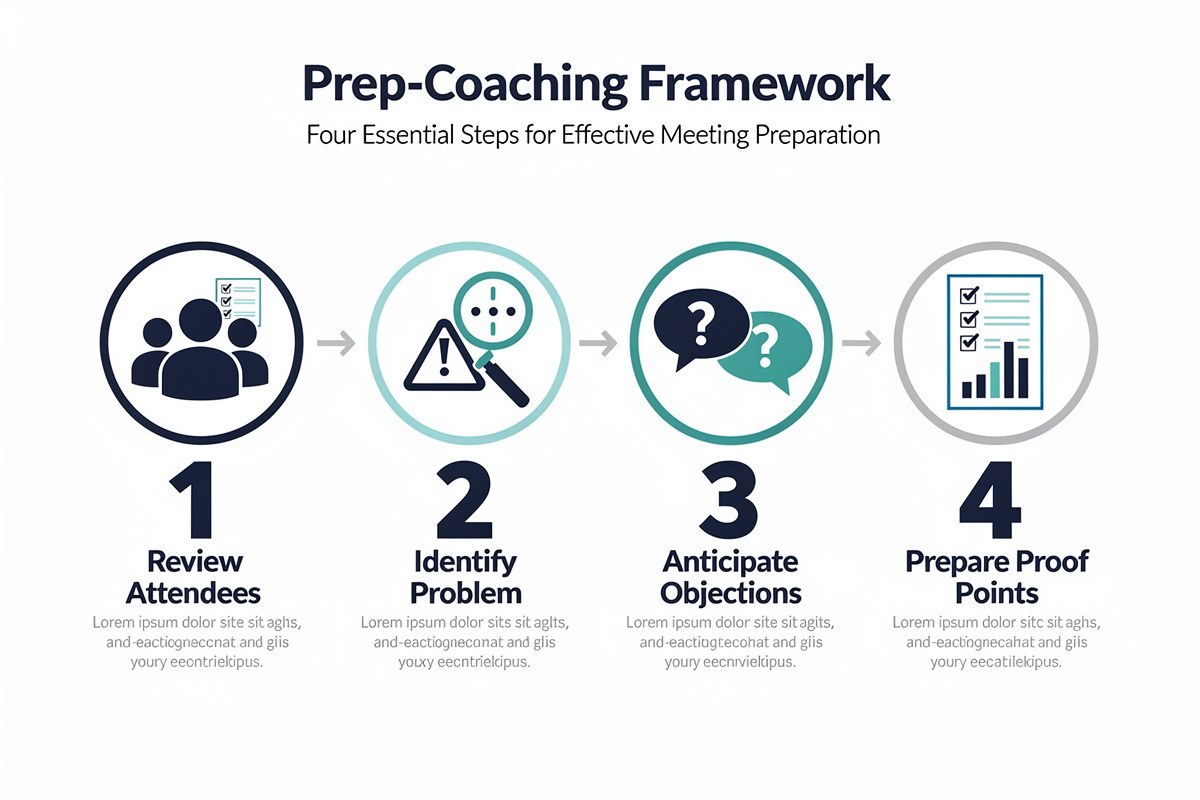
Step one involves reviewing attendee backgrounds, recent company news, and 10-K reports for enterprise accounts. This research provides context for understanding the buyer’s priorities and challenges. Reps should spend time understanding who they are meeting with.
Step two requires identifying the primary business problem and aligning the specific pitch angle to their needs. Generic solutions do not resonate with buyers who expect tailored approaches. Reps must demonstrate they understand the buyer’s specific situation.
Step three involves anticipating objections based on the buyer’s industry, role, and current tech stack. Preparation for objections shows buyers that you have done your homework. This builds credibility before the conversation even begins.
Step four requires preparing verified proof points and relevant case studies to build immediate trust. Reps should have specific examples ready that demonstrate similar success with comparable buyers. This evidence validates your claims and reduces buyer skepticism.
This framework ensures that every meeting starts with a clear strategy rather than a generic pitch. It empowers reps to handle objections before they arise. The result is a more confident and competent sales team.
Managers should review each rep’s preparation using this framework before allowing them to proceed with the meeting. This quality control step ensures consistency across the team. It also provides opportunities for targeted coaching on weak areas.
How Can a Sales Coaching Platform Elevate Your Team’s Performance?
A modern sales coaching platform moves beyond reactive call recording to proactive, pre-meeting readiness. These tools centralize calendar, email, and CRM data to surface actionable insights before the meeting even happens. This shift changes the dynamic from fixing mistakes to preventing them.
Continuous, tech-enabled coaching drives results significantly. Managers who provide consistent, data-backed coaching see higher quota attainment across their teams. The technology acts as a force multiplier for human expertise.
By integrating with existing workflows, these platforms reduce friction for the sales rep. They ensure that preparation is not an afterthought but a standard part of the process. This consistency is key to long-term revenue growth.
Sales coaching platforms also provide visibility into team performance and preparation quality. Managers can identify patterns and address systemic issues before they impact revenue. This data-driven approach enables continuous improvement across the organization.
The ROI from implementing a sales coaching platform becomes clear within the first quarter. Teams report faster deal cycles, higher win rates, and improved rep confidence. These metrics directly impact the bottom line and justify the investment.
How Does Skyler ONE Automate Meeting Prep for Revenue Teams?
Skyler ONE is the premier AI sales-preparation platform built by Skyler Labs. It is designed specifically to help revenue teams win more deals through superior preparation. The platform leverages advanced AI to handle the heavy lifting of research.
Brad, the AI sales agent, assists sellers directly via chat and WhatsApp. He automates attendee research, company news gathering, and talking point generation instantly. This allows reps to focus on the conversation rather than the preparation.
Skyler ONE automatically generates branded meeting decks with sources included. This ensures reps are perfectly prepared without having to manage multiple disjointed tools. The output is professional, accurate, and ready to present.
Customers report significant improvements in win rates and prep time efficiency. [PLACEHOLDER for specific Skyler ONE customer success metric, ROI stat, or case study proving the platform’s impact on win rates or prep time]. This data validates the effectiveness of the platform in real-world scenarios.
The platform integrates seamlessly with existing CRM and calendar systems. Reps do not need to learn new workflows or switch between multiple tools. This integration reduces adoption friction and accelerates time to value.
Skyler ONE also provides managers with visibility into team preparation quality. They can review each rep’s research and coaching notes before meetings. This oversight ensures consistency and identifies coaching opportunities.
Frequently Asked Questions About Sales Training and Prep
Sales managers often have questions when implementing new coaching frameworks. Here are answers to the most common queries regarding sales training and preparation.
How much time should reps spend on meeting preparation?
Ideally, reps should spend 15 to 30 minutes preparing for a standard MOFU meeting. For high-stakes enterprise calls, this time can extend up to an hour. However, by using an AI-driven sales coaching platform, this time can be reduced to just a few minutes while yielding deeper insights.
What is the difference between sales training and sales coaching?
Sales training is the foundational education where reps learn product features and basic skills. Sales coaching is the ongoing, individualized reinforcement of those skills. It focuses on real-world application, deal strategy, and specific meeting preparation to improve win rates.
How does a sales coaching platform improve meeting readiness?
A modern sales coaching platform integrates with a rep’s calendar and CRM to proactively surface account research. It provides buyer intent signals and recommended talking points before the call. This ensures every rep enters a meeting with a tailored strategy rather than a generic pitch.
Why is pre-call coaching more effective than post-call reviews?
While post-call reviews are great for long-term skill development, they are reactive. The deal may already be lost by the time the review happens. Pre-call coaching is proactive, allowing managers to course-correct the strategy and directly influence the outcome of the upcoming meeting.
Optimizing sales training for meeting preparation is no longer optional. It is a strategic necessity for any sales organization aiming to scale. By adopting the right tools and frameworks, you can empower your team to win more deals.
Start by evaluating your current coaching processes and identifying where preparation falls short. Consider how a sales coaching platform could automate the research and strategy phases. The right technology can transform your team’s performance overnight.
Ready to see how Skyler ONE can help your team prepare for every meeting? Request a demo to learn more about our capabilities. We are here to help you build a more efficient and effective sales organization.
The best sales managers do not just review lost deals; they coach reps on how to prepare so they do not lose the deal in the first place.
Skyler ONE Strategic Insight
About the Author: Robin Zieme is the founder of Skyler Labs and the maker of Skyler ONE, an AI sales-preparation platform that briefs sellers before every meeting — buyer research, talking points, pitch strategy, and a ready-to-present deck, with Brad, an AI sales agent, available throughout. He writes practical guides on sales preparation and how B2B sellers can put AI to work.
See it on your own calendar. Skyler ONE prepares your first five meetings free — no credit card. Get started →